




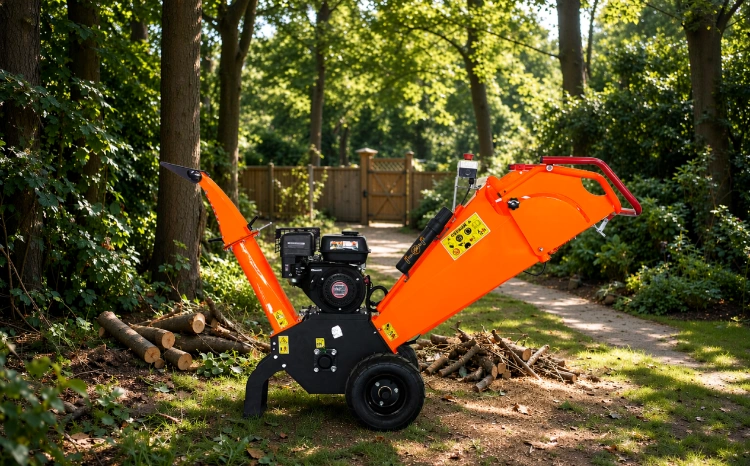
Narrow Garden Gates, Limited Space: How a Compact Wood Chipper Handles Branch Processing
04
November
A garden gate is what, 30 to 36 inches across? And that’s exactly where most branch piles end up — behind it. Hauling the stuff out armful by armful eats a whole Saturday, and half the neighborhoods out there won’t let you burn anyway. A compact wood chipper shortcuts the whole mess. The 4-inch petrol class weighs roughly 205 pounds, one person can roll it through a gate on air-filled tires, and it chips branches right where they dropped. You feed, it cuts, the pile disappears. What follows is the capacity question, the moving-and-storing question, and the checks I’d run before handing over money for one.
What Counts as a Compact Wood Chipper
The class is easy to spot once you know the shape of it. Walk-behind frame, petrol engine in the 196 cc neighborhood (4.1 kW on this one), chipping rating sitting near 4 inches, wheels with air in them instead of a tow hitch for your tractor. Petrol, corded electric, or PTO — that choice decides where you can actually run the machine, and I’d settle it first. We put the three power types side by side in an earlier post, so I’ll skip repeating it here.
Mechanically, nothing exotic happens inside. Branch goes in the hopper, twin hardened steel blades cut at it, chips fly out the discharge and land where you aimed. Blade speed in this class runs about 2,400 rpm. What actually separates a machine you’ll like from one you’ll cuss at? Blade steel, blade condition, and how much pushing the machine makes you do. That’s it.
What a 4-Inch Branch Capacity Covers
Four inches. Call it 100 mm if you think in metric. That rating decides everything about what you can feed, so let’s be concrete about it. Pruning cuts? Fine. Hedge trimmings, the twiggy stuff after you fell a small tree, storm branches off the lawn? All fine. Dry hardwood feeds slower than green softwood — a knotty oak limb wants patience, a fresh pine branch basically feeds itself.
What it won’t take is the other end of the log. Trunk sections, limb bases thicker than the rating, anything you have to stand on to break. That’s bigger-machine territory, and I mean that literally: 6- and 8-inch PTO machines, or the 150 mm towable sort. There’s a whole post on when the 150 mm class starts making sense, with the money math included. But if your branch piles are the usual suburban sort — under 4 inches, annoying, endless — the compact class isn’t a compromise. It’s just the right size.
One more thing worth knowing: the twin blades are reversible. When an edge wears, you flip the blade over and you’ve got a fresh cutting edge. Two blades, two edges each — that’s four working edges before anybody touches a grinder.
Through the Gate and Into the Shed
Now the part nobody puts on a billboard. Can you actually get the thing to the branches? The CS-100 ships at roughly 35 by 30 by 48 inches packed, 93 kg all in — 205 pounds, give or take. Nobody deadlifts that comfortably, but you don’t have to. Tip it back onto its pneumatic tires and it rolls: through the gate, down the side path, over lawn and gravel, right up to the pile. Try that with a towable machine. You can’t, and dragging branches out to the driveway instead is exactly the work you bought a chipper to quit doing.
Chips land where you want them too. The discharge chute swings a full 360 degrees, so the wheelbarrow, the compost corner, or the bed you’re mulching — your call, and you re-aim as the pile grows. Storage is the same story in miniature: it tucks into a shed corner and the tarpaulin that comes in the box goes over it. Your garden stays a garden.
A Short Checklist Before You Buy
Five checks. That’s the whole list, and none of them need a manual.
Check this first
Why bother
The usual small-yard answer
The narrowest gap on the route
The machine goes to the branches. Not the reverse.
A compact chipper clears a standard garden gate
How thick your branches get
The rating is what the engine chews without complaint
Pruning and storm debris mostly stays under 4 inches
Engine and starter
Petrol runs anywhere. A pull start means no battery to die on you
4.1 kW / 196 cc petrol, pull start
Where the chips can go
Aimed chips are tidy. Unaimed ones are a chore
360-degree swivel discharge
What’s actually in the box
Saves a second trip to the store
Goggles, ear defenders, tarpaulin, toolbox
About the maker, since it matters here. RIMA builds the whole family — firewood processors, sawmills, chippers, stump grinders — and ships them all over; their main site lists the range. The CS-100 is the portable end of that line, and it’s aimed squarely at landscapers, tree surgeons, and homeowners whose gardens have gates in them. If 4 inches sounds tight for your place, the bigger CS models sit on the same category page.
So where’s the line? Honestly, it’s not complicated. Suburban lot, branch piles that come back every season, storage measured in spare corners — get the compact petrol machine. You’ll use it, and it won’t swallow the yard. Got trunks to process, or a tractor sitting there with PTO hours to burn? Step up a class. The money turns into saved time fast enough. Buy for the branches you actually get. Not the fantasy firewood empire.
Still torn on the sizing? RIMA’s service team will match the machine to your gate, your branches, and your shed. Free of drama.
FAQ
Will a compact wood chipper handle hardwood branches?
Within the rating? Yes. The CS-100 runs twin reversible hardened steel blades, and hardwood or softwood both come out clean so long as the branch stays under 4 inches. Seasoned oak wants slow, steady feeding — a green pine branch practically feeds itself. Don’t shove. Let the blades take bites. That’s the whole technique, honestly.
Can one person move a 205-pound chipper around a yard?
Roll it? Yes. Lift it? No. The pneumatic tires carry the 93 kg frame over grass and gravel without drama, and tip the machine back onto its wheels and one operator can steer it through gates, down paths, around the rose bed. Two people only if there’s a step to heave it over. Day to day you’re just rolling it. One-person job.
What comes included with the CS-100?
Goggles, hearing protection, a tarpaulin, a toolbox. Small stuff — but think about it. Ear and eye protection belong on every session anyway. The tarp covers the machine between uses. The toolbox gives the spanners a home right next to the machine, so nobody hunts through the garage at 9 a.m. on a Saturday. Nice not to buy that kit after the fact.
How noisy is a petrol wood chipper?
Loud. Petrol engines swinging steel blades always are, which is why ear defenders ship in the box — use them, every session. Two habits keep the annoyance down: work in the open where the sound spreads instead of bouncing off walls, and pick your hours with the neighbors in mind. It’s a Saturday-afternoon noise, not a 7 a.m. one.
Where should the wood chips end up?
Wherever you point the chute, which is the fun part. Fresh chips work as mulch on beds and paths, they bulk out a compost pile, or they ride off in the wheelbarrow. Swing the discharge around as each pile grows so nothing spills over your boots — and if you lay a tarp down first, cleanup takes about ten seconds.